Table of contents
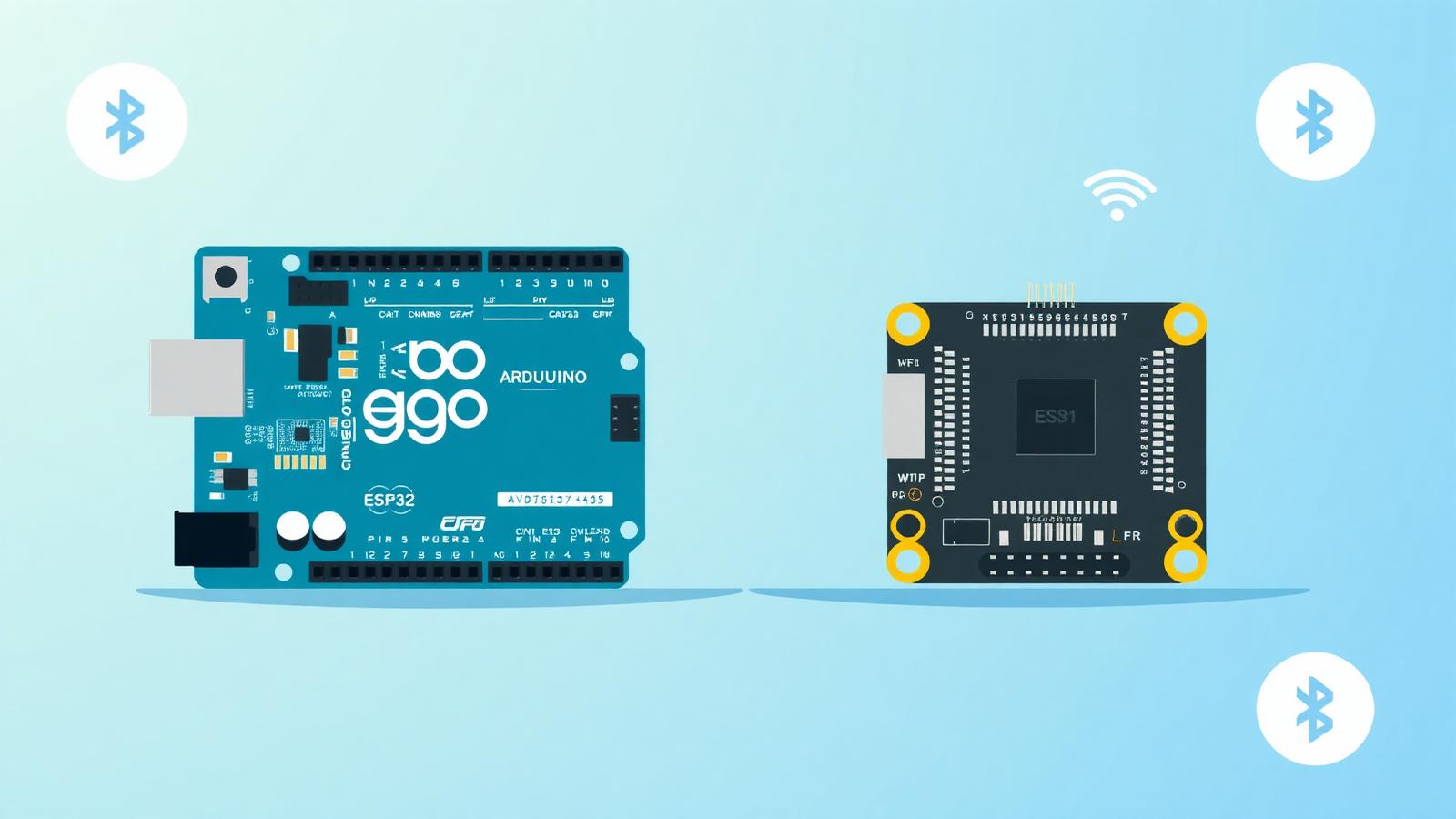
If you are just starting out in electronics, robotics or IoT, the first real decision you will face is picking a development board. Two names dominate almost every classroom, YouTube tutorial and college project — Arduino and ESP32. Both are excellent, both are affordable, and both are stocked individually at Ampex India. But they are not the same, and choosing the right one for your goal will save you weeks of frustration.
This guide is written for engineering students, diploma students, ITI learners, hobbyists and anyone who is deciding between an Arduino board and an ESP32 board in 2026.
What is Arduino?
Arduino is an open-source microcontroller platform that started in Italy in 2005. The most popular board in the family is the Arduino UNO R3, which uses the ATmega328P microcontroller running at 16 MHz with 32 KB of program memory and 2 KB of RAM. It has 14 digital I/O pins, 6 analog inputs and runs on a simple C/C++ based language through the free Arduino IDE.
Arduino became the industry standard for teaching because everything about it is beginner-friendly — the pin layout, the community, the documentation, the shields and the sheer number of tutorials available online. It is the safest place to learn how microcontrollers, sensors and actuators actually work.
What is ESP32?
The ESP32 is a much newer microcontroller developed by Espressif Systems. It is built around a dual-core Tensilica Xtensa LX6 processor that can run up to 240 MHz, with 520 KB of internal SRAM and support for up to 4 MB of external flash. Most importantly, the ESP32 comes with Wi-Fi and Bluetooth built into the chip itself.
That single design decision changed everything. Suddenly a board that costs less than most Arduino models could talk to the internet, host a web server, connect to a smartphone, or push sensor data to the cloud — with no extra modules required.
Major Differences at a Glance
Processor
- Arduino UNO: 8-bit AVR, single core, 16 MHz
- ESP32: 32-bit dual core, up to 240 MHz
Memory
- Arduino UNO: 32 KB flash, 2 KB RAM
- ESP32: 4 MB flash, 520 KB RAM
Connectivity
- Arduino UNO: none built-in (requires shields for Wi-Fi/Bluetooth)
- ESP32: Wi-Fi 802.11 b/g/n and Bluetooth Classic + BLE built-in
GPIO
- Arduino UNO: 14 digital + 6 analog
- ESP32: 34 GPIO with multiple ADC, DAC, touch, PWM and capacitive channels
Operating voltage
- Arduino UNO: 5V logic
- ESP32: 3.3V logic (be careful when mixing 5V sensors)
Price
- Both are very similar in India, but ESP32 usually offers more capability per rupee.
Performance Comparison
For blinking an LED, reading a sensor or driving a motor, both boards feel identical. The difference shows up when your project grows.
An ESP32 can run FreeRTOS out of the box, handle multiple tasks in parallel across two cores, read high-resolution ADC signals, drive a colour display, host a web dashboard, and stream data to the cloud — all at the same time. An Arduino UNO will happily do one or two of these things, but not all of them together.
For heavy computation, image processing, machine learning inference at the edge or IoT dashboards, the ESP32 wins comfortably. For learning the fundamentals of embedded programming and understanding what each register does, the Arduino UNO is still the better teacher because the environment is simpler.
Wi-Fi and Bluetooth
This is where the ESP32 stands in a league of its own. On an Arduino UNO you would need to add an ESP-01, HC-05 or SIM800 module to connect anything. On an ESP32 it is one library and a few lines of code.
If your project involves any of the following, choose ESP32:
- Home automation controlled from a mobile app
- IoT weather station uploading to a cloud dashboard
- Bluetooth-controlled robot
- Real-time sensor telemetry
- Voice assistant or smart display projects
- Any project that must be accessible over the internet
Programming Difficulty
Both boards are programmed through the Arduino IDE. That means the language, the way you write setup() and loop(), and most of the popular libraries feel identical. A student who has learned Arduino can move to ESP32 in an afternoon.
There are two small learning curves on ESP32:
- Managing 3.3V logic when connecting older 5V sensors.
- Understanding that some GPIO pins are reserved during boot or are input-only.
Neither is difficult once you follow a good pinout diagram.
Real-world Applications
Arduino UNO is perfect for
- Line-following and obstacle-avoiding robots
- Digital clocks, timers, counters
- LCD/LED based mini projects
- Sensor interfacing labs at diploma and ITI level
- Traditional analog experiments
ESP32 is perfect for
- IoT home automation with a mobile app
- Smart agriculture and irrigation
- Smart energy meters
- Bluetooth robots and gesture-controlled cars
- Cloud-connected weather stations
- Wearable and battery-powered projects (better sleep modes)
Which Board is Best for Beginners?
If your goal is to understand electronics from the ground up, start with Arduino UNO. You will learn how registers, pull-up resistors, ADC and PWM behave without any hidden abstractions.
If your goal is to build modern connected products as fast as possible, start with ESP32. You will still learn all the fundamentals, but you will be able to make Wi-Fi and mobile-app projects from week one.
Our honest recommendation for students in 2026: start with Arduino for the first 4-6 weeks, then move to ESP32. The transition is smooth and you get the best of both worlds.
Which Board is Best for IoT?
ESP32 — without question. It was designed for it. Everything from MQTT, WebSockets, HTTP servers, OTA updates, Bluetooth Low Energy, ESP-NOW mesh networking and cloud SDKs is available as a ready library.
Which Board Should You Buy at Ampex India?
Both boards are stocked individually, so you buy exactly the one your project needs — and add the second later without paying for parts twice.
- Arduino UNO R3 — ideal for absolute beginners learning digital pins, sensors, LEDs, buzzers and small mini projects.
- ESP32 DevKit V1 — ideal for students moving into IoT, robotics, motor control and app-based projects.
- Both together — the usual choice for final-year projects, industry-level prototypes and hackathons, paired with gas, PIR and flame sensors, relays and motors bought individually.
Buying Guide
Before you buy, ask yourself three quick questions:
-
What do I want to build in the next 30 days? If it involves the internet or a mobile app, pick ESP32. If it is a robot, LCD project or a sensor experiment, either board works.
-
Which components does that project actually need? List the board, sensors, modules, wires and power parts first, then order only those items. You avoid paying for parts you will never use.
-
Am I planning to grow into IoT eventually? If yes, buy an ESP32 alongside your Arduino when your first connected project starts — the rest of your sensors and modules carry over.
Final Verdict
Arduino teaches you electronics. ESP32 teaches you connected products. In 2026 the smartest students learn both — and that is exactly why we stock both boards individually.
Ready to start building real electronics projects? Explore development boards, sensors, modules and tools at Ampex India and begin your hands-on learning journey today.
Ready to build real-world electronics projects?
Browse genuine boards, sensors and modules at Ampex India and buy exactly the components your project needs.
Written by
Ampex India Team
Ampex India supplies quality electronic components and modules for engineering students, hobbyists and makers across India — combining reliable hardware with practical learning resources.
About Ampex India